How I Started Coding Without a Computer
How curiosity, paper, and free online resources became the beginning of my journey into software development.
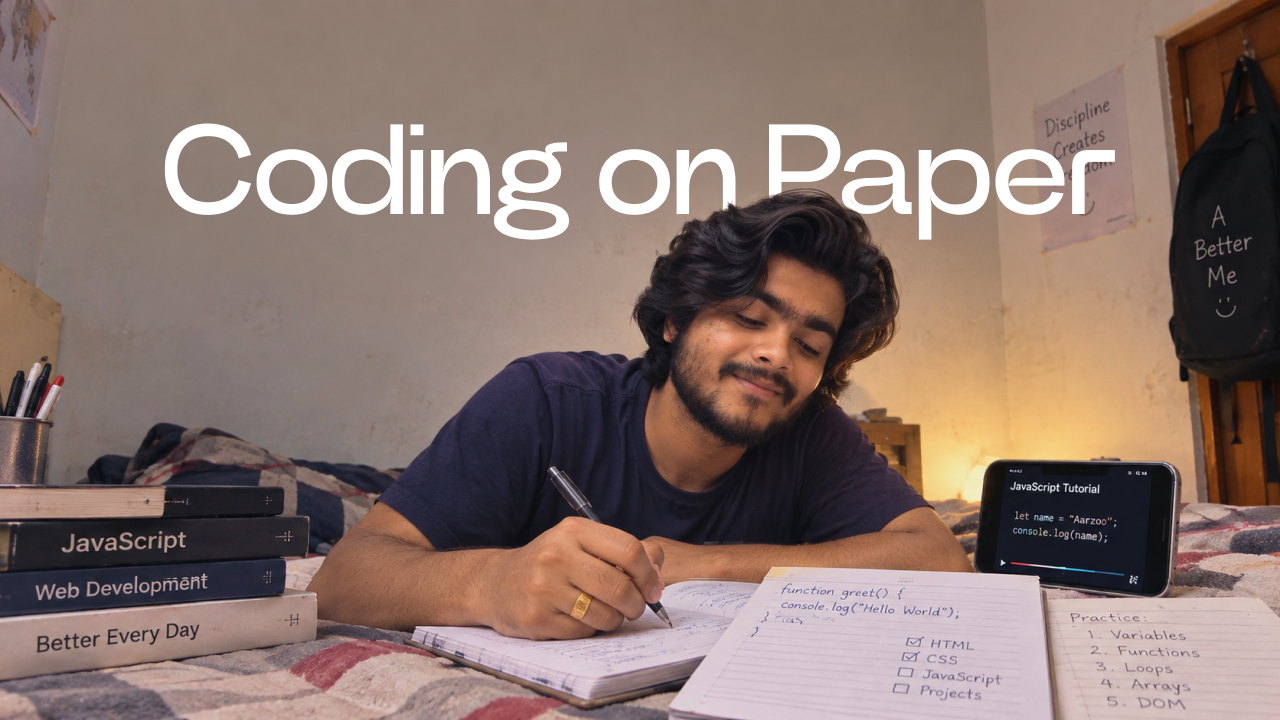
I started coding without a computer.
That sentence still feels a little strange to me because today, in 2026, learning to code often looks very different. You can open a browser, ask an AI tool to explain a concept, use an online editor, run code in the cloud, watch a tutorial, and build a complete application without leaving your desk. AI has also become a normal part of many developers’ workflows; Stack Overflow’s 2025 Developer Survey reported that 84% of respondents were using or planning to use AI tools in their development process. (Stack Overflow Developer Survey)
My beginning was much simpler.
I had curiosity.
I had a pen.
I had some paper.
And I wanted to understand how code worked.
I did not have a laptop sitting on my desk. I did not have a powerful computer. I did not have someone in my family who was already a software engineer and could guide me.
I was just a kid who became interested in technology and wanted to know how things worked.
That curiosity eventually changed my life.
It Started With Doraemon
I don't remember having some serious five-year plan to become a software engineer.
I was a kid.
Like many kids growing up with cartoons, I used to watch Doraemon. What caught my attention was not only the stories, but the strange world of technology inside them.
Robots.
Gadgets.
Machines.
Things that could solve problems.
Things that could do something that seemed impossible.
I became curious about robotics.
I started wondering how people actually built these things. How could a machine understand instructions? How could something created by a human behave in a certain way? What made technology work?
At that age, I didn't know the answers.
I just wanted to find them.
Around 2012, that curiosity slowly moved toward coding.
I didn't know yet that this would become such a big part of my life. I simply wanted to understand what programming was.
That is how my coding journey began.
Not with a laptop.
Not with a coding bootcamp.
Not with a computer science degree.
With curiosity.
I Didn't Have a Computer
This is probably the most memorable part of my early coding journey.
I didn't have a computer or laptop of my own when I first started learning.
Today, it is hard to imagine trying to learn programming without opening an editor and actually running the code. But when you really want to understand something, you start finding different ways to get closer to it.
I started learning from free resources on the internet, especially YouTube.
I would watch coding videos, listen to explanations, look at examples, and try to understand what was happening.
But there was one problem.
I couldn't always write and run the code myself.
So I started writing things down.
Paper became my editor.
Pen became my keyboard.
My imagination became the place where the code ran.
I would write syntax on paper and try to understand what each part was doing. I would think about what would happen if a condition became true. I would look at loops and try to follow them in my head. I would copy examples and slowly start changing them.
It was not the fastest way to learn.
It was not the easiest way to learn.
But it was my way.
Coding on Paper
When people hear “coding without a computer,” they may imagine someone memorizing programming languages.
That wasn't exactly what I was doing.
I was trying to understand the logic behind code.
There is something interesting about writing code on paper. You don't have a compiler waiting to tell you that you made a mistake. You don't have autocomplete suggesting the next function. You don't have an error message pointing at line 17.
You have to think.
You have to slow down.
You have to understand what the code is supposed to do.
Even today, I still think there is value in writing ideas down before typing them into a computer. Recent discussions around coding on paper make the same point: removing tools like autocomplete and instant feedback can force you to reason more carefully about the code and the logic. (By Hand)
I wasn't doing it because I had discovered some advanced learning method.
I was doing it because I didn't have another option.
And somehow, that limitation became part of my learning.
Learning From Free Resources
I also didn't have an expensive setup.
Most of my early learning came from free resources.
YouTube became one of the places where I could find explanations for almost anything I wanted to understand. I searched, watched, paused, rewound, and tried to follow along.
One video would introduce an idea.
Another video would explain something I didn't understand.
A third video would create a different example.
Then I would try to connect all of it in my head.
That process taught me something that I still use today.
You do not always need the perfect resource.
Sometimes you just need the willingness to keep searching until you understand something.
When I didn't understand a concept, I didn't have a teacher standing beside me. I had to search for another explanation.
That habit stayed with me.
Even now, when I face a difficult technical problem, my first instinct is usually not to panic. I start breaking the problem apart.
What do I know?
What don't I know?
What can I test?
What can I read?
What can I build?
That way of thinking started much earlier than my professional software engineering career.
From Curiosity to Real Coding
As my interest grew, I slowly moved from just watching and reading to actually trying to write more code.
I started learning programming concepts and experimenting with web development.
I made small things.
I broke small things.
I fixed them.
Then I broke them again.
That cycle became normal.
At some point, coding stopped feeling like a subject I was studying and started feeling like something I could use.
That was a big change.
A programming language was no longer just syntax.
It became a way to solve problems.
A website was no longer just a page.
It became something I could create.
An application was no longer something other people built.
I could try to build one too.
That shift in mindset was one of the most important moments in my journey.
I Was Learning Without a Traditional Tech Background
I come from a small semi-urban city in West Bengal.
There was no tech background in my family.
I didn't grow up surrounded by software engineers, developers, startup founders, or people working in technology. There wasn't someone at home who could tell me exactly which programming language to learn, which framework to use, or what a software engineering career looked like.
I had to discover those things myself.
That made the journey slower sometimes.
It also made it personal.
I had to ask questions that other people might already have answers to.
What should I learn?
Where should I start?
Which language matters?
What does a software engineer actually do?
How do people get jobs?
How do you build something real?
There were many things I didn't know.
But not knowing became another reason to keep learning.
The Internet Became My Classroom
I think one of the biggest advantages I had was access to the internet.
I didn't have a traditional mentor, but I had access to people who shared what they knew.
Tutorials.
Documentation.
Forums.
Videos.
Projects.
Source code.
Communities.
Over time, the internet became my classroom.
I could learn from someone working thousands of kilometers away from me. I could see how another developer approached a problem. I could read documentation written by the people who actually built a technology.
That changed what was possible for someone like me.
I could start from almost nothing and slowly build knowledge.
The learning was not always organized.
Sometimes it was messy.
Sometimes I jumped between topics.
Sometimes I learned something too early.
Sometimes I had to come back months later and understand it properly.
But I kept moving.
Eventually, I Got Access to a Computer
As I gained more access to computers and could practice more directly, my learning changed.
Now I could actually write code.
I could run it.
I could see errors.
I could search for solutions.
I could change something and immediately see what happened.
It was exciting.
The things I had been writing on paper could finally become real.
I could create something and watch it work.
That feeling is difficult to explain if you have never experienced it.
You write a few lines.
You run them.
Something happens.
And you realize that you made the machine do something.
That feeling was one of the reasons I stayed interested in programming.
It was not only about getting a correct answer.
It was about creating something that didn't exist a moment earlier.
From Small Experiments to Real Projects
Once I had better access to computers, I started building more seriously.
I learned web development.
I explored different technologies.
I created websites and software.
I experimented with ideas.
Eventually, I started building for other people too.
That was a major turning point.
There is a huge difference between writing code for yourself and writing software that another person depends on.
When you build something for yourself, you can change the rules whenever you want.
When you build something for a real client, there is a real problem to solve.
There are requirements.
There are expectations.
There are users.
There are deadlines.
There are changes.
And sometimes there are bugs that appear at the worst possible time.
That experience taught me that software development is much bigger than writing code.
You have to understand people.
You have to communicate.
You have to make decisions.
You have to take responsibility for what you build.
That lesson eventually became a big part of my journey with DGISight.
Building dgisight
Around 2022, I started dgisight, my own software development agency.
At the beginning, it was simply another thing I wanted to build.
Then real clients started coming in.
Over roughly a year, I worked with more than 25+ clients across different industries, including hospitals, schools, and personal businesses. I built websites, software, and applications for people in my local area and for clients from other parts of India.
For someone who started by writing syntax on paper because he didn't have a computer, that felt surreal.
But the bigger achievement was not the number of clients.
It was what I learned from doing real work.
I had to listen to people.
I had to understand what they actually wanted.
I had to turn their ideas into something technical.
I had to deliver.
I had to fix things when they broke.
I had to keep learning because every project could bring a new problem.
The real world became another classroom.
The Hard Part Was Not Always Coding
One of the biggest things I learned is that coding is often not the hardest part.
Sometimes the hardest part is figuring out what should be built.
Sometimes it is explaining a technical problem to someone who doesn't write code.
Sometimes it is deciding between two approaches.
Sometimes it is fixing something that looked simple but turned out to be much more complicated.
Sometimes it is simply staying consistent when you are tired.
Building software teaches you patience.
It teaches you to deal with uncertainty.
It teaches you that the first solution is not always the final solution.
These lessons did not come from a textbook.
I learned them by actually doing the work.
Applying to Companies
While I was learning and building, I also started applying to companies and startups.
Around 2022 and 2023, I applied to more than 40+ companies on my own.
There were many applications.
There were many unknowns.
There were moments when I wondered whether all the time I was spending learning and building would actually lead somewhere.
But I kept going.
I didn't have a guaranteed path.
I didn't have a traditional computer science degree completed at that point.
I simply had the skills I had built, the projects I had worked on, and the experience I had gained.
Eventually, things started moving.
I got a four-month internship experience with Wipro.
Later, I worked at Adobe as a Software Engineer for around seven months.
Going from writing code on paper to working professionally as a software engineer is still something I think about sometimes.
The path was not obvious when I started.
It became clear only after I had walked it.
The Strange Thing About My Journey
There is something ironic about my story.
I started coding without a computer.
Then I spent years learning software development.
I built websites and applications.
I started an agency.
I worked with real clients.
I worked professionally as a software engineer.
And now I spend my time building software products of my own.
In a world where someone can generate a piece of code with a prompt in seconds, my earliest memory of coding is still a piece of paper.
That's why I think my beginning matters.
Not because learning without a computer is somehow better.
It isn't.
Having a computer makes learning programming much easier because you can practice, run code, debug problems, and build real applications.
My point is different.
I had very little.
But I still started.
Coding in the AI Era
Now we live in a very different period of software development.
In 2026, AI coding tools can explain code, generate code, help with debugging, and speed up many parts of development. The 2025 Stack Overflow Developer Survey showed how deeply AI tools have entered developer workflows, while also showing that developers still have concerns about accuracy and often need to verify AI-generated output. (Stack Overflow Blog)
Sometimes I think about what my younger self would have thought about today's tools.
Imagine telling that kid who was writing programming syntax on paper that one day he would be able to talk to an AI and get working code in seconds.
It would sound like something from Doraemon.
But here we are.
Still, I don't think the fundamentals have changed as much as the tools have.
Curiosity still matters.
Problem solving still matters.
Understanding what you are building still matters.
Being able to read code still matters.
Being able to ask good questions still matters.
And knowing why the code works matters even when a tool helps you write it.
Technology changes quickly.
The habit of learning is what stays.
What Not Having a Computer Taught Me
Looking back, I learned a few important things from that period.
The first is that starting matters more than having the perfect setup.
I could have waited until I had a good laptop.
I could have waited until someone taught me.
I could have waited until I had the right course.
I didn't.
I started with what I had.
The second is that limitations can change how you learn.
Because I couldn't run code immediately, I had to think more carefully about what I was writing.
I had to imagine what the code would do.
I had to understand the logic before seeing the output.
I would never say someone should avoid using a computer to learn programming. You absolutely should practice with a computer when you have access to one. But I am grateful that my beginning forced me to slow down and think.
The third is that curiosity can take you surprisingly far.
I didn't know where coding would lead me.
I wasn't thinking about becoming the founder of a company.
I wasn't thinking about building an online file converter.
I wasn't thinking about becoming a software engineer.
I was just curious.
Sometimes that's enough to get started.
What I Would Tell Someone Starting Today
If you are reading this because you want to learn coding but don't have a laptop right now, I understand that feeling.
You may think you have to wait.
You may think everyone else is ahead of you.
You may think you need an expensive computer before you can begin.
My story doesn't mean you can build everything without a computer. At some point, serious software development requires real practice on a machine. But you don't have to wait for the perfect moment to start learning.
You can start by understanding programming concepts.
You can read code.
You can learn how variables, conditions, loops, functions, data structures, and algorithms work.
You can write examples on paper.
You can use whatever access you have to technology.
You can watch tutorials carefully instead of just watching them passively.
You can write things down.
You can ask questions.
And when you finally get regular access to a computer, you can turn that knowledge into real practice.
The important thing is not to confuse starting small with thinking small.
Small beginnings are still beginnings.
I Still Have the Same Curiosity
Even after all these years, I think the reason I continue building software is very similar to the reason I started.
I am still curious.
I still want to know how things work.
I still like taking an idea and turning it into something real.
That is why I keep building products under oxzeen.
That is why dgisight continues as part of the oxzeen ecosystem.
That is why I built Let It Convert.
That is why I create web development content through CodeWithAarzoo.
That is why I continue solving programming problems.
The tools have changed.
The projects have changed.
My skills have changed.
But the curiosity is still there.
From Paper to Production
If I had to describe my coding journey in one sentence, it would probably be this:
I went from writing code on paper to building software that real people use.
That journey did not happen overnight.
It took years.
There were periods when I felt lost.
There were moments when I questioned myself.
There were things I didn't understand.
There were projects that didn't go as planned.
There were applications that didn't work out.
There were plenty of bugs.
There were plenty of late nights.
But there were also moments when something finally clicked.
A project worked.
A client was happy.
Someone used something I built.
A difficult problem finally had a solution.
A job opportunity came through.
A product went live.
Those moments made all the effort feel worth it.
Where I Am Now
Today, I am no longer the kid who has to imagine code running on a piece of paper.
I have computers.
I have development tools.
I have access to documentation, communities, open source projects, and AI tools.
I have professional experience.
I have clients.
I have products.
I have much more knowledge than I had when I started.
But I still consider myself a learner.
There is always another technology to understand.
Another system to explore.
Another problem to solve.
Another idea to build.
And that is what I like about software.
There is always another thing to figure out.
The Beginning Still Matters
Sometimes people only see the current version of a developer.
They see the projects.
They see the GitHub profile.
They see the job title.
They see the startup.
They see the products.
They don't see the beginning.
They don't see the kid sitting somewhere without a laptop, watching coding tutorials and writing syntax on paper.
They don't see the uncertainty.
They don't see the small experiments.
They don't see all the times I had to search for an answer because nobody around me knew it.
They don't see how far away the final destination seemed at the beginning.
I think that's why I wanted to write this story.
Not to say that my path was perfect.
It wasn't.
Not to say that everyone should learn coding without a computer.
They shouldn't if they have access to one.
And not to say that having fewer resources makes someone automatically successful.
It doesn't.
I just want to remember where I started.
Because sometimes, when you are focused on where you want to go next, it is easy to forget how far you have already come.
From Doraemon to Software Engineering
It still makes me smile when I think about the connection.
A cartoon sparked an interest in robotics.
That interest turned into curiosity about computers.
That curiosity turned into coding.
Coding turned into learning.
Learning turned into building.
Building turned into client work.
Client work turned into dgisight.
That journey led to professional software engineering experience.
And eventually, it led me to oxzeen and the products I am building today.
I never planned the entire path.
I simply kept following the next question.
How does this work?
How can I build this?
Why did this break?
Can I make it better?
What happens if I try?
Those questions took me from paper to production.
And maybe that is the most important thing I learned from starting coding without a computer.
You don't need to know the entire journey before you take the first step.
Sometimes you just need enough curiosity to take the first one.
Mine started with Doraemon, a pen, a piece of paper, and a question: “How does this work?”
I’m still asking that question today.